Stay up to date with the latest news
Subscribe to our telegram channel

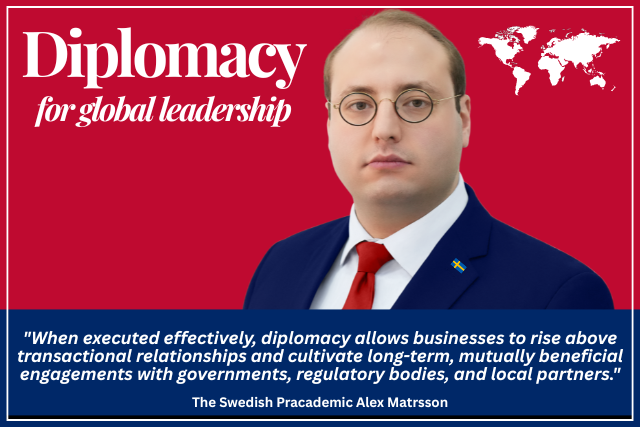
The New Frontier: Diplomatic Rigor in the Pursuit of Global Sustainable Competitive Advantage
Tashkent, Uzbekistan (UzDaily.com) — In an exclusive interview with Mr. Alex Matrsson, the Swedish Pracademic and International Business Strategist, he articulates that the contemporary global business environment, marked by interconnected markets and evolving geopolitical dynamics, has elevated diplomacy beyond its traditional confines to a central strategic pillar in leadership. For business leaders, integrating diplomacy into international business strategy is not a mere operational function. It is a sophisticated tool that shapes the trajectory of corporate growth, risk management, and long-term sustainability.
According to Mr. Matrsson, diplomacy extends beyond governmental negotiations or conflict resolution. It serves as a dynamic force that aligns business objectives with the socio-political, economic, and regulatory landscapes that define global markets. Business leaders guiding multinational enterprises must appreciate that modern business strategy operates within not only financial and competitive frameworks but also the intricate contexts of politics, culture, and governance. Mr. Matrsson emphasizes that diplomacy plays an essential role in navigating complex international environments, managing cross-border relationships, and mitigating risks.
In today’s globalized economy, companies no longer function in isolation, as Mr. Matrsson observes. They belong to a global ecosystem, where each market is shaped by unique political, cultural, and economic forces. The challenge for business leaders lies in recognizing that business success depends not solely on financial expertise or market positioning, but on the art of diplomacy. When executed effectively, diplomacy allows businesses to rise above transactional relationships and cultivate long-term, mutually beneficial engagements with governments, regulatory bodies, and local partners. In his view, a leader skilled in diplomatic strategy helps organizations influence, rather than merely react to, the political and regulatory conditions they face.
The significance of diplomacy becomes particularly clear during market entry, a process Mr. Matrsson highlights. Navigating local laws, trade regulations, and cultural nuances is essential. A company’s entry strategy must align not just with legal requirements but also with local governance and economic priorities. Building relationships with political leaders, regulatory agencies, and influential local stakeholders is crucial to smoothing the path for market access and mitigating regulatory uncertainty. Diplomacy, as Mr. Matrsson stresses, is not only about opening doors but also about establishing long-term, sustainable pathways for business success.
Managing geopolitical risk is another area where diplomacy proves indispensable, according to Mr. Matrsson. The unpredictable nature of global politics, trade agreements, and domestic policy changes can have significant consequences for business operations. To mitigate these risks, business leaders must adopt a sophisticated diplomatic approach that provides flexibility to navigate fluctuations. Effective diplomacy involves fostering long-term relationships with political and business leaders to anticipate and influence key decisions. Rather than reacting to political events as they unfold, companies benefit from this forward-thinking approach to safeguard against regulatory changes, trade restrictions, and tariffs.
Equally important is the engagement with international bodies and organizations that shape global trade and economic governance. As Mr. Matrsson explains, diplomacy enables business leaders to effectively represent a company’s interests within these forums, fostering collaborative agreements that open new market opportunities while safeguarding against disruptions. By weaving diplomacy into strategic frameworks, businesses not only protect themselves from risks but also play an active role in shaping the policies and regulations that affect their operations.
Cultural diplomacy, as Mr. Matrsson points out, plays a vital role in cross-border relationships. The ability to navigate a web of cultural expectations, business practices, and social norms is essential for success in foreign markets. Cultural diplomacy, however, is not simply about avoiding misunderstandings. It involves aligning business strategies with the cultural fabric of the market. Business leaders must recognize that business does not occur solely through contractual obligations, but also through interpersonal relationships grounded in trust, respect, and cultural understanding. This awareness allows businesses to adjust their strategic approaches, facilitate smoother negotiations, and establish deeper, more resilient partnerships.
In certain regions, decision-making processes may be hierarchical, with a small group of influential leaders making key decisions. In others, speed and efficiency are prioritized. As Mr. Matrsson explains, business leaders skilled in cultural diplomacy guide businesses in understanding these dynamics and adapting accordingly. Relationships built on mutual respect for local customs pave the way for partnerships that remain robust not just in the short term, but over the long haul.
In a world increasingly fraught with volatility, Mr. Matrsson underscores the critical importance of crisis diplomacy. Business leaders must be equipped to manage political, economic, and social disruptions effectively, whether arising from regulatory shifts, geopolitical conflicts, or economic downturns. In such instances, Mr. Matrsson advises engaging with local governments, industry leaders, and stakeholders to address immediate concerns while safeguarding long-term interests. A diplomatic approach to crisis management is grounded in thoughtful, measured engagement, emphasizing collaboration and conflict resolution rather than confrontation.
Maintaining open communication channels and transparency with stakeholders is paramount during a crisis. Diplomacy plays a key role in facilitating this dialogue, ensuring that a company’s actions align with the interests of both local governments and international partners, thereby protecting its reputation and long-term viability. Mr. Matrsson points out that, through diplomacy, companies can mitigate reputational risks and ensure business continuity during challenging times.
In conclusion, Mr. Alex Matrsson, the Swedish Pracademic and International Business Strategist, underscores that diplomacy is not a peripheral concern in international business strategy; it is a core strategic asset. For business leaders, leveraging diplomatic expertise is essential to navigating global markets, managing geopolitical and cultural risks, and fostering long-term relationships with key stakeholders. Diplomacy provides companies with tools to anticipate and influence regulatory changes, shape cross-border partnerships, and manage crises effectively.
Mr. Matrsson advocates that diplomacy empowers businesses to move beyond mere reactions to global events and to position themselves as proactive participants in the ever-evolving global landscape. As the intricacies of international business become increasingly interwoven with political, cultural, and economic forces, the role of diplomacy will only grow more significant. Business leaders who embrace and apply diplomatic principles effectively, he argues, will be well-equipped to guide their organizations through the complexities of the global marketplace, ensuring they remain competitive, resilient, and adaptable in an era of unprecedented change.
About Mr. Alex Matrsson
Mr. Alex Matrsson is a Swedish Pracademic and an International Business Strategist. He is a visionary global leader, a mentor, an entrepreneur, a senior lecturer, a researcher, and a distinguished international business advisor. He is the number one International Business Strategy graduate in Sweden. He has extensive experience initiating, running, and managing businesses across the global value chain, as well as working internationally with investors, SMEs, MNCs, government agencies, universities, and multidisciplinary research institutes. Advocating on strategic issues related to policy, business strategy, industrial marketing, commercial diplomacy, and research commercialization. When it comes to higher education, Mr. Matrsson believes in serendipity, innovation, and the power of synergy-making. Therefore, these concepts jointly constitute the springboard for his knowledge dissemination endeavors. He implements a pragmatic approach that is rigorous in nature. He systematically ensures the successful delivery of core business concepts, while simultaneously developing the students' ability to become reflexive thinkers. He aims to enable the students to operationalize their "state-of-the-art" knowledge constructively—so that they can become an invaluable source of prosperity, driving forward the "social" and "economic" well-being for their local communities, their regions, and the larger society, worldwide. His scientific endeavors consolidate around trade promotion, emerging markets, business resilience, and the network approach to internationalization. Mr. Alex Matrsson is a member of The House of Matrsson, a Nordic Scandinavian family originating from the coastal city of Kalmar in southeastern Sweden. Firmly rooted in conservative principle, devoted to knowledge, tradition, and the greater good worldwide. Finally, on a personal level, his wide-ranging interests include blue whales, Arabian horses, classical music, ethical capitalism, religion, culture, the Nordics, the GCC region, and Central Asia—particularly Kazakhstan.