Stay up to date with the latest news
Subscribe to our telegram channel

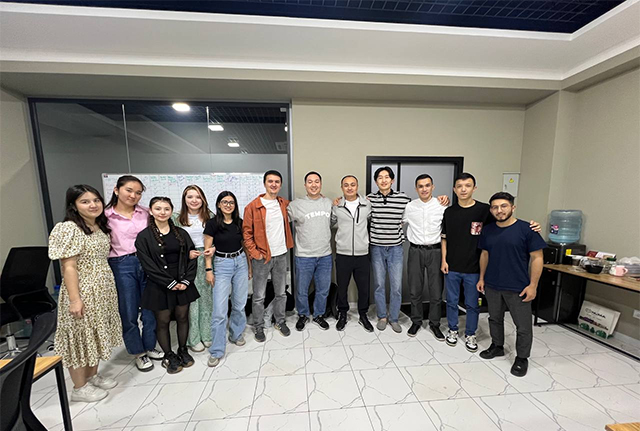
CyberNet AI develops voice agents for Uzbek call centers
Tashkent, Uzbekistan (UzDaily.com) — Uzbek startup CyberNet AI has developed a platform of voice AI agents capable of serving customers in Uzbek and Russian, automating contact center operations in banking, retail, and telecommunications, according to Startupbase.
According to the company’s CEO Sardor Khoshimov, the implementation of the solution can reduce call center costs by up to five times compared to human operators.
The company offers three core products. The first consists of machine learning-based bots operating on predefined scenarios: they conduct conversations, record customer responses, and convert speech into text. The second is a generative AI agent that does not require scripted dialogue; operators define communication parameters via prompts, after which the system independently generates responses based on customer queries. The third product is designed for analyzing incoming calls: after uploading recordings to the platform, it can identify operator errors, deviations from scripts, and the quality of customer interactions.
The technological foundation of the platform was developed in-house without using existing foreign solutions, and it can be deployed either in the cloud under a SaaS model or on the client’s own servers — in both cases, data remains within Uzbekistan. Khoshimov emphasized that local data processing not only meets security requirements but also improves voice communication quality, as reliance on foreign services often causes noticeable delays that reduce natural conversation flow.
Building its own language model was the most challenging stage of the project. One of the main obstacles was the lack of high-quality training data in the Uzbek language: in everyday speech, users frequently mix Uzbek and Russian, use regional dialects, and in some cases elements of the Karakalpak language. To address this, developers trained the model on a corpus of Turkic languages, including real business dialogues in Uzbek, Kazakh, and Kyrgyz. It took six months to build a working prototype, another year and a half to improve its quality, and a total of four years to develop a model capable of understanding spoken Uzbek and conducting full dialogues.
The AI agents are capable not only of answering standard questions but also of analyzing the emotional state of the caller in real time, detecting changes in tone, irritation, and other behavioral signals. In addition to voice calls, the platform integrates with SMS channels, chats, mobile applications, and websites, processing text requests alongside voice interactions.
The effectiveness of AI operators has already been confirmed through commercial cases. In one telecommunications project, conversion rates for upselling services reached 14–15% for AI agents, compared to 10–11% for human operators. To achieve such results, CyberNet AI analyzes calls from top-performing human agents before each deployment and trains its AI systems on their sales and communication techniques.
Khoshimov also emphasized that the company’s goal is not to replace human workers, but to relieve them of routine tasks. Large-scale outbound calling, which requires significant human resources, can be handled by AI agents, while human operators can focus on complex cases requiring a more nuanced approach.