Stay up to date with the latest news
Subscribe to our telegram channel

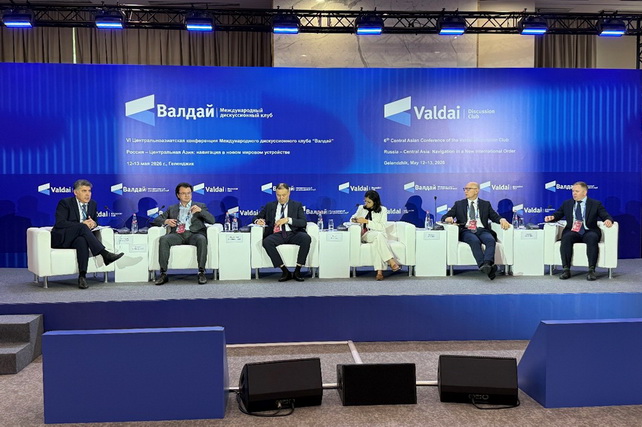
Valdai Club Discusses Central Asia–Russia Cooperation in Eurasia
Tashkent, Uzbekistan (UzDaily.com) — A recent VI Central Asia Conference of the Valdai Discussion Club titled “Russia – Central Asia: Navigating a New World Order” was held in Gelendzhik, bringing together representatives of leading analytical and research centers from Central Asian countries, Russia, China, India, Mongolia, and other states.
The agenda focused on the development of cooperation between Russia and Central Asian states amid the transformation of international relations, strengthening regional security, transport and logistics connectivity, and interaction in trade, economic, scientific, educational, and cultural spheres.
From the Russian side, participants included representatives of the Russian Ministry of Foreign Affairs, IMEMO RAS, the Institute of Oriental Studies of the Russian Academy of Sciences, HSE University, MGIMO, Kuban State University, Tomsk State University, as well as administrations of Krasnodar Krai and the city of Gelendzhik.
A large delegation from Uzbekistan also participated, including leadership and experts from the Institute for Strategic and Interregional Studies (ISMI), the Center for Economic Research and Reforms (CERR), the International Institute for Central Asia (IICA), and the Institute for Macroeconomic and Regional Studies.
While moderating the second session on priorities of Central Asia–Russia cooperation, First Deputy Director of ISMI Akramjon Ne'matov noted that long-term cooperation must take into account the fundamentally new role of Central Asia. According to him, consistent policies of good-neighborliness and practical cooperation have strengthened regional resilience, increased subjectivity, and transformed Central Asia into one of the key centers of economic and transport-logistics connectivity in Eurasia.
It was emphasized that Central Asia is gradually shifting from a peripheral transit zone to a key crossroads of East–West and North–South routes. Countries in the region aim not only to use their geographic position but also to capitalize on it by forming industrial hubs, production chains, and high value-added logistics services along transport corridors.
In essence, the region is moving from a transit model to an industrial-logistics integration model, where transport corridors drive deeper industrialization and integration into new value chains.
According to Ne'matov, this new role of Central Asia should form the basis for a constructive and mutually beneficial agenda between Russia and the region’s countries.
It was also noted that Central Asian states pursue open policies and seek constructive relations with all external partners. The region is not interested in confrontation and views Eurasia as a space for broad, inclusive, and mutually beneficial cooperation.
The representative stressed that the modern world is undergoing deep transformation marked by growing uncertainty and reduced global stability. In this context, regional responsibility for ensuring stable and predictable development environments is increasing. For Central Asian states, Eurasia naturally serves as a framework of historically established economic, transport, and humanitarian interconnectedness.
Ne'matov stated that Uzbekistan consistently pursues a policy of building an open and mutually beneficial Eurasian cooperation space.
Within this strategy, through multilateral platforms such as the CIS, SCO, EAEU, CICA, ECO, and OTS, Uzbekistan promotes a practical agenda focused on transport connectivity, industrial cooperation, energy collaboration, and the development of sustainable value chains. Since 2016, Uzbekistan has put forward dozens of initiatives aimed at deepening regional integration and expanding economic cooperation.
Building on this, the country’s top leadership has been developing a comprehensive regional agenda aimed at strengthening trust and institutionalizing cooperation in Central Asia.
President Shavkat Mirziyoyev has advanced several key initiatives, including the development of a Code of Good Neighborliness, Trust and Cross-Border Partnership, as well as the Samarkand Initiative of Solidarity for Common Security and Prosperity.
It was emphasized that the objective is not isolation, but the formation of a resilient and open region. This approach strengthens Central Asia as a stable and fast-growing market while enhancing its role as a logistics hub and center of industrial growth.
The discussion also highlighted the growing consolidated nature of Central Asia as a region with increasing subjectivity. This enables more effective internal governance while positioning the region as an independent factor of stability in Eurasia. Central Asia is thus emerging as one of the foundational elements of the Eurasian architecture, and supporting this trend aligns with the interests of external partners.
Particular attention was given to the growing strategic importance of the Central Asia–Russia format. Industrial cooperation, joint infrastructure projects, energy collaboration, and humanitarian ties were identified as key drivers of stability across the Eurasian space.
In conclusion, Ne'matov stressed that Central Asia is moving beyond its former perception as a buffer zone and asserting itself as an independent actor with its own agenda. Its strategic goal is to build open and mutually beneficial cooperation with all external partners while taking responsibility for regional security, stability, and sustainable development.
A strong, economically interconnected, and stable Central Asia serves the strategic interests of all actors in the Eurasian space.
In conditions of global transformation, regional cooperation formats provide the foundation for new stability, he said, noting that Uzbekistan’s policy of regional responsibility aims to build a practical model of constructive partnership in which cooperation with Russia is a key element of long-term development and Eurasian stability.