Stay up to date with the latest news
Subscribe to our telegram channel

Uzbekistan, ADB discuss new regional investment mechanisms
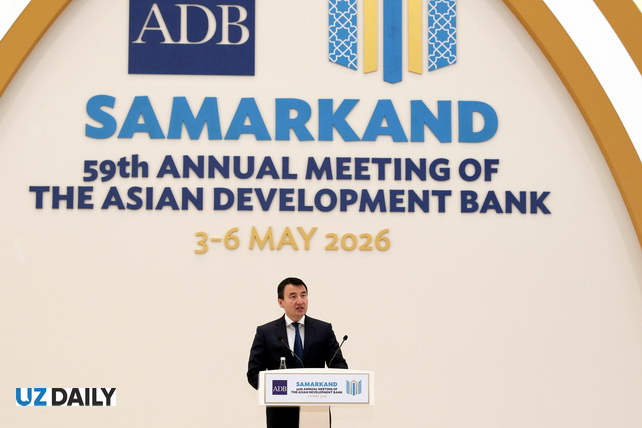
Tashkent, Uzbekistan (UzDaily.com) — Uzbekistan and the Asian Development Bank (ADB) have discussed the launch of new mechanisms to attract high-quality and sustainable foreign direct investment (FDI) in the Central Asian region, according to a seminar held in Samarkand during the 59th Annual Meeting of the ADB Board of Governors.
The event was opened by ADB President Masato Kanda and Deputy Prime Minister of Uzbekistan Jamshid Khodjaev. Participants included leading economists, lawyers, and heads of international financial institutions.
A key announcement during the seminar was the planned establishment of the Tashkent International Financial Centre. According to the outlined plans, the centre is expected to become fully operational by early 2027 and will offer investors a jurisdiction based on English common law, supported by independent judicial and regulatory structures.
Residents of the centre will also benefit from a competitive tax regime, including long-term exemptions from taxes on profits, dividends, and capital gains.
Khodjaev stated that Samarkand—historically a key hub of the Silk Road—is once again becoming a place where strategic decisions for the entire region are made.
He noted that international confidence in Uzbekistan’s reform agenda is reflected in tangible economic results. In 2025, the country’s GDP grew by 7.7 percent, surpassing US$147 billion.
The deputy prime minister also highlighted sovereign rating upgrades by S&P, Fitch, and Moody’s to “BB” with a positive outlook, describing this as a significant achievement reflecting the systemic nature of ongoing reforms.
Alongside the financial centre initiative, Uzbekistan is implementing a broad package of legislative reforms. A draft law on alternative investment funds is being prepared to create a modern legal framework for private equity and venture capital operations.
Amendments are also being introduced to the Civil Code to legalize instruments widely used in international practice, including call and put options, escrow accounts, and indemnification mechanisms. These changes are intended to reduce legal risks for foreign investors and improve asset management flexibility.
ADB President Masato Kanda said that foreign investment flows to environments where confidence exists, and that confidence is built on transparent rules, strong institutions, and predictable dispute resolution mechanisms.
The bank has been cooperating with Uzbekistan since 1995, supporting reforms in investment legislation, including the law on international commercial arbitration, as well as training judges, lawyers, and business representatives. Kanda confirmed ADB’s readiness to continue supporting the development of a transparent and sustainable investment environment in the region.
A key outcome of the partnership is the Roadmap for Sustainable Investment Policy Reforms in Uzbekistan, developed jointly with the Organisation for Economic Co-operation and Development (OECD). The document covers competition policy, investment facilitation, responsible business conduct, and support for energy and digital transition.
According to Khodjaev, measures related to ESG standards have already improved the country’s position in international technology readiness rankings.
Participants in the discussion sessions included Deputy Minister of Investments, Industry and Trade of Uzbekistan Shokhrukh Gulamov, ADB Chief Counsel Thomas Clark, and ADB Country Director for Uzbekistan Kanokpan Lao-Araya. They discussed regional integration prospects and the concept of a Regional Alliance of Investment Councils for Central Asia and the Caucasus, intended as a platform for cross-border project support. Experts also highlighted the importance of the CAREC Agreement on trade and investment facilitation as a practical tool for regional economic cooperation.
At the conclusion of the event, Khodjaev invited participants to the 5th Tashkent International Investment Forum, scheduled for 16–18 June 2026. He said the forum would serve as a global platform for discussing investment resilience and new partnerships amid ongoing geopolitical and geo-economic shifts. A key expected outcome is the signing of a memorandum on establishing the Regional Alliance of Investment Councils.