Stay up to date with the latest news
Subscribe to our telegram channel

Kazakhstan Launches First Rain-Making Project in Region
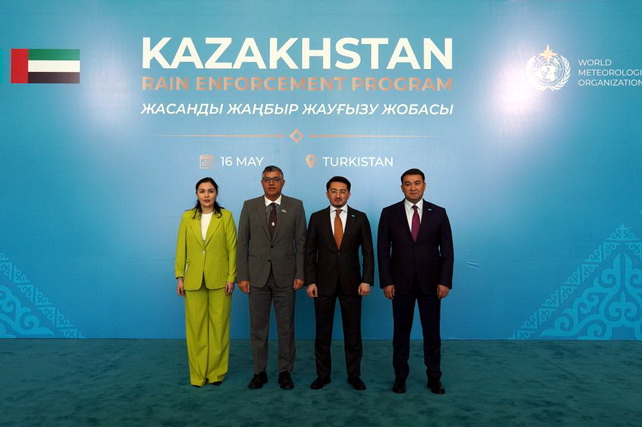
Tashkent, Uzbekistan (UzDaily.com) — A ceremonial launch of a project on artificial precipitation enhancement was held in Turkestan on May 16, with Kazakhstan becoming the first country in Central Asia to begin practical use of artificial rain technologies.
The project is aimed at increasing the filling of reservoirs and improving water supply for agricultural areas in the southern regions of the country. Full-scale implementation is scheduled to begin on 17 May 2026.
The initiative is intended to mitigate the effects of drought and water shortages affecting agricultural lands in the Turkestan region, which covers more than 911,000 hectares of arable land.
The project is being implemented in cooperation with the UAE National Center of Meteorology, which has extensive experience in weather modification and artificial rainfall technologies.
The ceremony was attended by Kazakhstan’s Deputy Prime Minister and Minister of Artificial Intelligence and Digital Development Zhaslan Madiyev, President of the World Meteorological Organization and Director General of the UAE National Center of Meteorology Abdullah Ahmed Al-Mandoos, UAE Ambassador to Kazakhstan Mohammed Said Mohammed Al-Areiki, and Turkestan region governor Nurlkhan Kushirov.
Madiyev said Kazakhstan is taking a practical step toward building a new system of climate resilience.
“For the first time in the region, a project of this scale in artificial precipitation technology is being launched. For us, this is the beginning of building modern climate infrastructure based on science, international partnership, and digital technologies,” he said.
According to international assessments, artificial rain technologies can increase precipitation levels by 10 to 20 percent compared with natural conditions. Similar solutions are already used in China, the United States, the UAE, France, and Saudi Arabia.
The project will be implemented locally in areas with the highest water demand, primarily in agricultural zones. Target areas are selected jointly by meteorological experts and relevant government bodies, taking into account weather conditions, environmental factors, and water needs.
Authorities emphasized that the technology has a localized impact radius of no more than five kilometers and is not associated with large-scale weather formation. Salt-based reagents commonly used in international cloud seeding practices will be applied.
The initiative is expected to improve agricultural water supply efficiency, reduce drought-related losses, and support crop productivity growth. The potential economic impact is estimated at up to 35 billion tenge annually.
Under the cooperation program, specialists from the UAE National Center of Meteorology are training local experts in Turkestan region in weather modification technologies, including meteorologists, pilots, engineers, and other specialists.
Expansion of the technology to other regions of Kazakhstan is also under consideration, along with the creation of a national climate technology base.
The project involves multiple government agencies, including ministries responsible for artificial intelligence and digital development, water resources and irrigation, ecology and natural resources, agriculture, transport, energy, emergency situations, as well as KazAeroNavigation and Kazhydromet.