Stay up to date with the latest news
Subscribe to our telegram channel

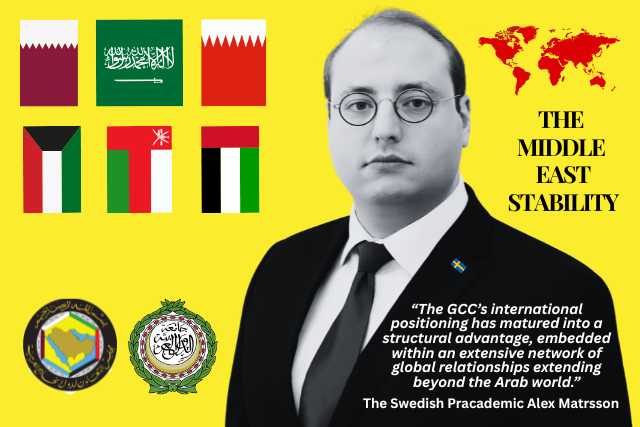
Geopolitical Resilience and the Institutional Ascendance of the GCC Nations
Tashkent, Uzbekistan (UzDaily.com) — In an exclusive Senior Advisor Interview, the Swedish Pracademic and International Business Strategist, Mr. Alex Matrsson, advocates that the current regional tensions in the Arabian Gulf and the wider Middle East, as Mr. Matrsson frames it, are shaped by a strategic confrontation between the United States of America and Iran. In his assessment, the Gulf Cooperation Council nations (GCC), comprising the Kingdom of Saudi Arabia, the United Arab Emirates, the State of Qatar, the State of Kuwait, the Kingdom of Bahrain, and the Sultanate of Oman, are not direct participants in this confrontation. He notes that while they did not define the origins or strategic trajectory of these tensions, their geographic position along the Arabian Gulf and their centrality in global energy systems place them in a structurally exposed position when escalation occurs.
Mr. Matrsson argues that this exposure renders the region strategically unavoidable during periods of heightened tension. He frames the Arabian Gulf not as a source of instability but as a critical junction where external rivalries translate into operational and economic consequences. In such an environment, he emphasizes that stability is determined less by declaratory policy and more by disciplined execution, calibrated diplomacy, and sustained restraint in escalation dynamics.
From a governance and resilience perspective, Mr. Matrsson highlights the GCC’s capacity to maintain internal continuity under external pressure. He points to strong fiscal frameworks, consolidated state institutions, and mature security architectures as indicators of governance systems designed for continuity and long-term policy planning rather than reactive adjustment.
Mr. Matrsson further observes that the GCC’s international positioning has matured into a structural advantage. The region is embedded within an extensive network of global relationships extending beyond the Arab world. These linkages operate across energy markets, investment flows, diplomatic engagement, and security coordination, reinforcing the GCC’s reputation as a stable and predictable actor within an increasingly fragmented global order.
By contrast, Mr. Matrsson notes that the League of Arab States continues to face persistent challenges in achieving sustained coordination. While member states retain full sovereignty and operate within distinct national contexts, he identifies the absence of durable integration mechanisms as a structural limitation on collective effectiveness.
According to Mr. Matrsson, this is attributable to uneven institutional development across member states, divergent economic trajectories, and varying levels of administrative capacity. These conditions manifest in limited policy alignment and ongoing disparities in education systems, infrastructure development, and socio-economic outcomes, which collectively constrain deeper regional coordination.
Against this backdrop, Mr. Matrsson argues that the GCC has pursued a markedly different developmental path. Member states have invested significantly in institutional modernization, economic diversification, and large-scale infrastructure expansion. Education systems have been progressively restructured, with increasing emphasis on international academic partnerships, research capacity development, and human capital formation. These efforts, he emphasizes, have reinforced governance models centered on long-term planning, efficiency, and policy continuity.
Mr. Matrsson also observes that in the Arab world outside the GCC, it is becoming increasingly difficult to identify higher education systems that consistently meet global benchmarks. Within the GCC, however, he identifies a deliberate strategic commitment to education as a core pillar of national development, with measurable spillovers into public administration effectiveness and private sector competitiveness.
In Mr. Matrsson’s assessment, this divergence is gradually shaping external perceptions of the region. While the GCC is widely regarded as institutionally coherent and developmentally forward-leaning, perceptions in parts of the broader Arab world remain uneven, reflecting structural disparities rather than differences in strategic intent.
On this basis, Mr. Matrsson raises broader questions regarding the long-term strategic value of continued participation in the League of Arab States for the GCC. In his view, the framework demands significant diplomatic engagement while delivering limited operational return relative to the GCC’s current economic scale and institutional maturity.
At the same time, Mr. Matrsson underscores the importance of maintaining selective and constructive engagement with Arab partners where alignment exists on development priorities and institutional capacity. In other contexts, he suggests that cooperation may be more effectively pursued through targeted initiatives, particularly in humanitarian coordination and technical collaboration, rather than broad institutional integration.
In conclusion, Mr. Matrsson highlights that the long-term stability of the Arabian Gulf region will depend on sustained internal cohesion within the GCC, deeper economic and security integration, and a calibrated approach to external partnerships that prioritizes strategic value while reinforcing its role as a stable anchor within the global system.
About Mr. Alex Matrsson
Mr. Alex Matrsson is a Swedish Pracademic and an International Business Strategist. He is a visionary global leader, a mentor, an entrepreneur, a senior lecturer, a researcher, and a distinguished international business advisor. He is the number one International Business Strategy graduate in Sweden. He has extensive experience initiating, running, and managing businesses across the global value chain, as well as working internationally with investors, SMEs, MNCs, government agencies, universities, and multidisciplinary research institutes. Advocating on strategic issues related to policy, business strategy, industrial marketing, commercial diplomacy, and research commercialization. When it comes to higher education, Mr. Matrsson believes in serendipity, innovation, and the power of synergy-making. Therefore, these concepts jointly constitute the springboard for his knowledge dissemination endeavors. He implements a pragmatic approach that is rigorous in nature. He systematically ensures the successful delivery of core business concepts, while simultaneously developing the students' ability to become reflexive thinkers. He aims to enable the students to operationalize their "state-of-the-art" knowledge constructively—so that they can become an invaluable source of prosperity, driving forward the "social" and "economic" well-being for their local communities, their regions, and the larger society, worldwide. His scientific endeavors consolidate around trade promotion, emerging markets, business resilience, and the network approach to internationalization. Mr. Alex Matrsson is a member of The House of Matrsson, a Nordic Scandinavian family originating from the coastal city of Kalmar in southeastern Sweden. Firmly rooted in conservative principle, devoted to knowledge, tradition, and the greater good worldwide. Finally, on a personal level, his wide-ranging interests include blue whales, Arabian horses, classical music, ethical capitalism, religion, culture, the Nordics, the GCC region, and Central Asia—particularly Kazakhstan.