Stay up to date with the latest news
Subscribe to our telegram channel

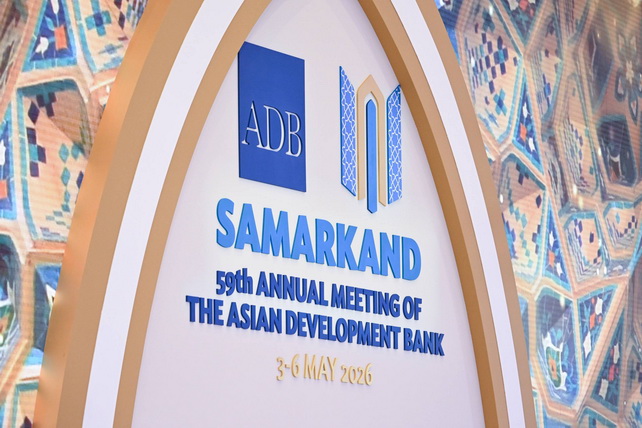
ADB Unveils Asia-Pacific Connectivity Strategy in Samarkand
Tashkent, Uzbekistan (UzDaily.com) — At the concluding session of the 59th Annual Meeting of the Asian Development Bank (ADB) in Samarkand, the bank’s leadership presented ambitious plans to strengthen regional connectivity through energy, digital, and financial integration across the Asia-Pacific region. Five of the bank’s six vice presidents took part in discussions focused on the region’s development outlook.
The session was moderated by Bruno Carrasco, ADB Secretary, who opened by recalling Samarkand’s historical role as a key trading hub on the Silk Road in the 14th and 15th centuries. Against this backdrop, the annual meeting was titled “Crossroads of Progress: Advancing a Connected Future for the Region.”
A central focus of the discussion was the Pan-Asia Power Grid initiative presented by ADB Vice President for South, Central, and West Asia, Yingming Yang. He noted that over several decades ADB has supported nine subregional programs covering 42 countries in Asia and the Pacific, with seven of them directly supporting cross-border electricity trade.
The new initiative received unanimous support from the bank’s shareholders following its announcement by President Kanda. Preliminary estimates suggest that by 2030 the project will improve electricity access for more than 200 million people, reduce emissions from the energy sector by 15%, and create around 840,000 jobs. Economic benefits from efficiency gains are projected at about $100 billion in the coming years, rising to $250 billion by 2030.
Yang said the initiative will act as a catalyst for smaller economies in the region, enabling countries such as Bhutan, Nepal, Türkiye, and Tajikistan to turn hydropower resources into economic growth, jobs, and income while allowing connected countries to access cleaner energy for industrial competitiveness.
By 2030, ADB aims to mobilize $50 billion in investment, add 20 gigawatts of renewable energy capacity, and construct 22,000 kilometers of transmission lines. The bank will also launch $10 million in technical assistance to support policy dialogue and standards harmonization.
ADB Vice President for Finance and Risk Management Roberto Casali emphasized the importance of regional corridors and a systems-based approach. He said connectivity is no longer limited to physical infrastructure but concerns how markets, systems, and institutions interact. Countries, he added, must view shared resources as interconnected systems rather than isolated national assets.
Casali highlighted three lessons from regional cooperation: reducing fragmentation and improving predictability for investors; ensuring private capital flows when enabling conditions are in place rather than through declarations alone; and recognizing the role of public finance in early-stage development where markets are not yet mature.
He cited the “From Glaciers to Farms” initiative as an example of ADB’s role in linking nine countries and four river basins under a unified platform, coordinating rules and mobilizing private capital for development goals.
Vice President for Market Solutions Bargav Desai Gupta outlined the private sector perspective, saying investors require not only returns but also policy stability and predictability. He stressed the need for institutions, dispute resolution mechanisms, and harmonized standards for energy systems, payments, and trade, as well as integrated regional capital markets to reduce financing costs and support innovation.
ADB Vice President for Administration and Corporate Management Yu Hong Kim described work in Pacific island states, where infrastructure needs are high but markets are too small and remote for standalone projects. ADB is bundling project portfolios with partners such as the World Bank and has created an online platform listing upcoming projects.
A business fair in Fiji at the end of May has already attracted more than 400 companies. The initiative allows firms to access not only Fiji but also broader regional development portfolios, demonstrating a practical model of regional cooperation.
The discussion also focused on digital transformation. Carrasco noted the launch of the Asia-Pacific Digital Highway initiative with about $20 billion in investment. The initiative aims to connect energy systems, transport corridors, financial markets, and public services through digital infrastructure.
Vice President for Sectors and Themes Fatima Yasmin outlined four pillars: investment in cross-border fiber-optic corridors, submarine cables, data centers, cloud infrastructure, and digital public infrastructure such as digital ID and payments; policy and regulatory harmonization for data flows and cybersecurity; inclusive digital access for underserved groups; and integrated management of cyber risks and responsible AI governance.
Yu Hong Kim provided examples of advanced technology use, including an AI-based bird monitoring system at a wind energy project in Uzbekistan that pauses turbines when birds approach within one to two kilometers, a bamboo tokenization project generating carbon credits for small farmers, and a climate risk analytics tool using open data to assess disaster risks in three dimensions.
The final session addressed capital mobilization. ADB reported significant growth in private investment mobilization, reaching about $9.5 billion in 2025, up 40% from 2024, which itself rose 60% from 2023. Of this, $4.7 billion came from direct private capital mobilization.
Casali noted that the financing gap in Asia-Pacific is estimated at $1.5–1.7 trillion, requiring private sector participation. He highlighted new instruments including blended finance, guarantees, risk-sharing mechanisms, and catastrophe bonds, including a pioneering Central Asian disaster risk bond launched for Kyrgyzstan and Tajikistan.
The meeting concluded that long-term planning, policy coordination, and blended financing are essential for delivering large-scale regional infrastructure. The next ADB Annual Meeting will be held in Nagoya, Japan, where the bank will continue advancing its agenda for inclusive, resilient, and sustainable growth in the Asia-Pacific region.