Stay up to date with the latest news
Subscribe to our telegram channel

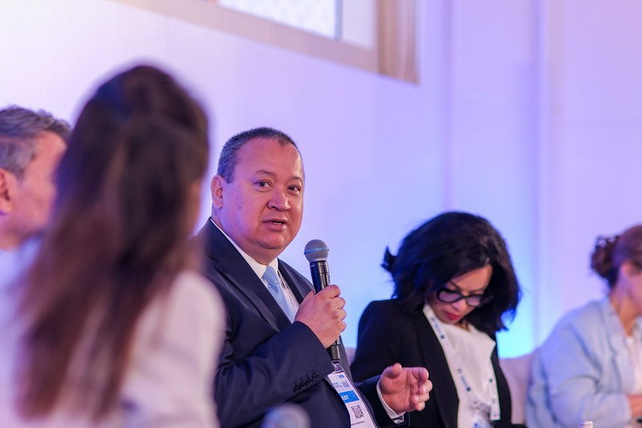
ADB Launches Agri-Innovation Alliance for Food Security
Tashkent, Uzbekistan (UzDaily.com) — At a session of the Asian Development Bank (ADB) in Samarkand, leading scientists, financiers, and government officials warned that worsening food and water security risks in the Asia-Pacific region could escalate into a full-scale food crisis within months amid volatility in fertilizer and energy markets.
Following the session, ADB formally announced the launch of a trilateral agri-innovation partnership with Japan and the United Arab Emirates.
Ismahane Elouafi, Executive Director of CGIAR and listed among Time magazine’s 100 most influential people in 2025, described the situation as a fertilizer and energy crisis that is rapidly evolving into a food security emergency. She noted that around 30% of global fertilizer exports pass through the Strait of Hormuz, with most supplies directed toward Asia, where ammonia- and nitrogen-based fertilizers are critical for agricultural production.
Elouafi said the world has experienced three fertilizer shocks in six years — during the COVID-19 pandemic, after the start of the war in Ukraine, and now due to tensions in the Middle East. She warned that timing is critical as the Northern Hemisphere is in the peak planting season, making countries that failed to secure fertilizer supplies particularly vulnerable.
She stressed that resilience is not built during crises but in between them, calling for long-term investment in science, alternative agricultural technologies, and national research systems.
Li Fung Lee, Director of Land and Water Resources at the Food and Agriculture Organization (FAO), supported the assessment and said the crisis also presents opportunities to improve fertilizer efficiency. He noted that excessive fertilizer use in many Asian countries is already contributing to soil degradation and water pollution.
According to FAO data, one-third of global agricultural land is already degraded, with more than 60% of human-induced land degradation occurring in croplands and pastures.
Li highlighted ongoing FAO soil mapping programs in seven countries — five in Africa and two in Central America — where thousands of soil samples are being collected to build digital national databases that provide farmers with precise fertilizer recommendations.
He also said Thailand has initiated a proposal for a UN Decade of Soil Health for 2031–2040, which could be adopted at an FAO conference next year.
Elouafi pointed to two scientific breakthroughs that could reshape global agriculture. Japanese researchers have identified a biological nitrification inhibitor gene that can be embedded into wheat and millet to improve nitrogen uptake efficiency. Researchers at the University of California, Davis, are developing similar technologies for maize, wheat, and rice. Both innovations are expected to reach commercial application within two to three years.
Attention was also given to Uzbekistan’s position. Zhusipbek Kazbekov, Deputy Minister of Ecology, Environmental Protection and Climate Change, said the country has restructured its environmental governance by transforming the ministry into a National Committee on Ecology and Climate Change reporting directly to the president.
He said the reform has improved interagency coordination across agriculture, water management, and environmental protection, and accelerated decision-making. He added that 80% of Uzbekistan’s territory consists of desert, and a new International Center for Desert Economics was established two months ago.
Kazbekov noted that Uzbekistan has implemented a large-scale reforestation program on the dried Aral Sea seabed, planting around 2 million hectares in recent years. The country’s protected natural areas now exceed 6 million hectares, and the saiga antelope population has returned to the region.
On water security, he said 90% of Uzbekistan’s water resources originate in neighboring countries through the Syr Darya and Amu Darya river basins, and 90% of this water is used in agriculture.
He outlined Uzbekistan’s three-pronged water diplomacy approach, including negotiations with Afghanistan on the Koshkupyr canal project, investment in hydropower projects in Kyrgyzstan’s Naryn River basin in exchange for guaranteed water quotas, and strengthening regional institutions such as the Interstate Commission for Water Coordination and the International Fund for Saving the Aral Sea.
Kazbekov expressed hope that the ADB initiative “From Glaciers to Farms,” with financing of about US$3.2 billion including Green Climate Fund resources, will support adaptation to glacier loss, which has declined by one-third in the region over the past 50 years.
Asset manager Mirova presented blended finance models as key tools for mobilizing private capital for sustainable land-use projects. Sébastien Duquesne, Head of Institutional Investor Relations at Mirova, cited a Moroccan smart drip irrigation project for date palms and citrus fruits that reduced water use by 30% while maintaining or increasing yields.
Mirova manages about €40 billion in assets, including €35 billion from private institutional investors such as Japanese and Australian pension funds, European insurers, and family offices. Duquesne said private investors typically require returns above 10–12% annually, which emerging agricultural markets often cannot provide without risk-sharing mechanisms such as public first-loss capital.
Tierr Gabbadin, Executive Director of the Climate Investment Funds (CIF), highlighted the organization’s first public bond issuance of US$500 million on the Singapore Exchange. The bond received AA+ ratings from Fitch and Aa1 from Moody’s and was oversubscribed six times, with 60% purchased by the private sector.
She said the bond’s success was driven by portfolio quality, diversification across six regions, and backing by six major development banks. She also described a climate resilience program in Cambodia covering seeds, farmer training, irrigation infrastructure, 13,000 km of roads, and crop insurance.
At the conclusion of the session, ADB officially announced the creation of an agri-innovation partnership between the ADB, the Japan Fund for Prosperous and Resilient Asia and the Pacific, and the UAE Presidential Court’s International Affairs Office.
The partnership will develop AI-based tools for weather forecasting, soil analysis, fertilizer optimization, and digital advisory services for farmers. The UAE will contribute US$1.5 million to an ADB trust fund, marking the first direct financial contribution from the emirate to ADB mechanisms.
Winfried Wicklein, Director General of ADB’s Sector Group, closed the session by urging a shift from pilot projects to systemic solutions, emphasizing that water, agriculture, and ecosystems must be financed as an integrated system rather than separately.