Stay up to date with the latest news
Subscribe to our telegram channel

Uzbekistan Overhauls Urban Planning With Digital Reforms
Tashkent, Uzbekistan (UzDaily.com) — With urban residents now a majority for the first time, Uzbekistan is overhauling its entire construction and city-planning apparatus — digitizing master plans, introducing escrow accounts for homebuyers, and criminalizing rogue developers.
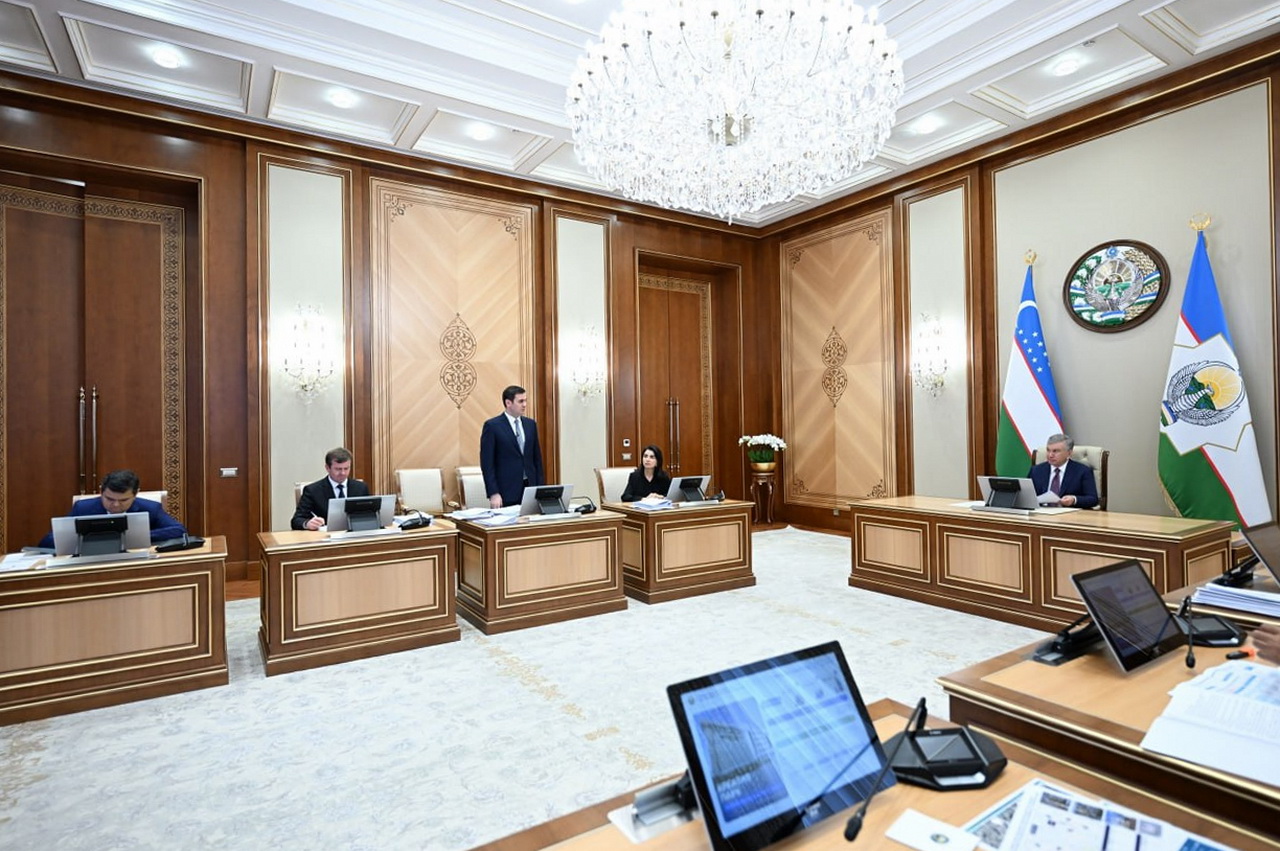
President Shavkat Mirziyoyev reviewed a sweeping reform presentation on urbanization and urban development efficiency, covering digital transformation of planning processes, shared construction regulation, housing renovation, and industry workforce development.
A Nation Tipping Urban
The urbanization shift is the reform's driving context: Uzbekistan's urban population has crossed 50% and continues to climb, making comprehensive territorial planning, green space preservation, historical heritage protection, and infrastructure development pressing national priorities.
Currently, general development plans exist for only 2,506 of the country's 8,604 populated localities. A further 154 plans are scheduled for completion in 2026 and 144 in 2027. More than 1,000 existing plans have already been converted to digital format.
However, a critical coordination gap has emerged: despite 275 master plans being developed for specific territories in 2024–2025, no unified tracking system exists and the documents remain unintegrated with general plans. To fix this, a new urban planning document management system will be introduced — encompassing data updates, digitization, monitoring, and a single information and analytics platform. Any planning document not entered into the new unified electronic registry will carry no legal force. The Urbanization Center will receive expanded powers to manage the urban planning geoinformation system and coordinate sector-wide work.
Escrow Accounts and the "Uy-joy" Platform
The shared construction market has grown rapidly but dangerously. Apartment construction under shared schemes has grown 2.5-fold in recent years, exceeding 11 million square meters last year. Yet violations have surged in parallel: in 2025 alone, nearly 3,000 citizens suffered losses totaling 668 billion soums.
A new draft law on shared construction addresses this directly. Its centerpiece is the introduction of escrow accounts: buyers' funds will be held in an authorized bank and transferred to developers only upon fulfilment of defined construction milestones. In the event of contract termination, buyers receive a full refund.
Accompanying these protections will be the "Uy-joy" unified digital platform, making publicly available data on developers, permitting documentation, construction progress, escrow accounts, and signed contracts. A universal construction object identifier, along with digital passports for territories, projects, and individual properties, will link data across state information systems and enable lifecycle monitoring of all construction projects.
Tackling Illegal Construction and Retraining the Workforce
Enforcement is also being tightened. In 2025, authorities recorded 1,952 cases of illegal construction, prompting proposals to significantly increase financial penalties for violations.
On workforce development, the Tashkent Technical School of Geodesy and Cartography is to be reorganized into a School of Urban Studies, Geodesy, and Cadastre, while Tashkent Architectural and Construction University will open a faculty of Modern Urban Studies and Agglomeration Management. Creative parks combining urbanism, architecture, and design are planned for all regions, with tax incentives for their residents.
Renovating the Soviet-Era Housing Stock
Urban renewal rounds out the reform agenda. Authorities identified approximately 17,000 residential buildings constructed before 1991 as candidates for replacement with modern, energy-efficient apartment complexes. A draft law on urban renovation has been prepared, defining procedures for establishing renewal zones, securing residents' consent, organizing resettlement and compensation, and setting investor obligations and state authority mandates.
President Mirziyoyev concluded by stressing that urbanization must be built on principles of comfortable living environments and sustainable territorial development. Responsible agencies were directed to accelerate the digitization of general and master plans, roll out the Uy-joy platform, protect citizens' rights in shared construction, and establish transparent mechanisms for renovation project implementation.
#Shavkat Mirziyoyev