Stay up to date with the latest news
Subscribe to our telegram channel

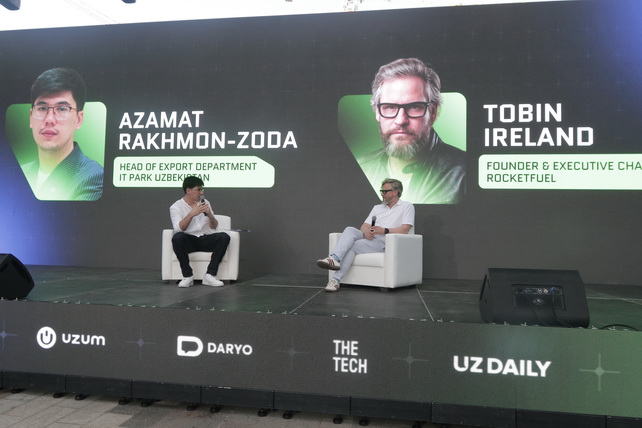
Tobin Ireland: Tashkent Could Become a Global Game Studio Hub
Tashkent, Uzbekistan (UzDaily.com) — Tobin Ireland, founder and executive chairman of the British gaming company RocketFuel, said at the Global Tech Weekend x TECH FEST forum in Tashkent that he considers the Uzbek capital one of two final candidates for hosting his company’s next production studio. The other finalist is Hanoi. According to Ireland, the decision will depend on the depth of local talent, business stability, and government support.
He stressed that the planned facility is not an outsourcing unit for routine tasks, but a full creative hub designed to become part of a global, round-the-clock production chain.
RocketFuel currently has a core team of 50 developers based in Lahore, Pakistan. If the Uzbekistan office is launched, the company plans to build a team of similar size.
Ireland pointed to the economic logic of the model, noting that a 150-person team distributed between Lahore, Tashkent, and Hanoi would cost five times less than an equivalent team in Los Angeles. However, he said cost savings are only one factor, alongside creative potential and local animation culture.
Addressing the Uzbek audience, Ireland urged founders to identify their own “Peak Games”—a company capable of triggering an ecosystem-wide ripple effect. He referenced the example from Türkiye: just five years ago, the country was not widely seen as a major gaming market, but after Peak Games was sold to Zynga for 1.8 billion dollars in 2020, around 80 new companies emerged from its alumni network.
He argued that such milestones build ecosystems faster than government programs alone. He outlined three foundations for success: a steady pipeline of technical graduates interested in game development, political and economic stability, and active state participation in shaping the industry.
Ireland also said RocketFuel plans to launch its own Roblox Academy in selected locations. The program will target developers with at least two years of experience in Unity and help them transition into UGC content creation.
Discussing broader industry trends, he described a structural shift in gaming driven by post-pandemic investment cycles and the decline of traditional AAA game development, which often requires three years of work and budgets exceeding 100 million dollars with uncertain outcomes.
As major studios downsized, indie studios and UGC platforms filled the gap. Roblox, he said, is the clearest example of this transition, with 370 million monthly active users and more than 2 billion dollars paid to creators. Around 83% of users are outside the United States, while 70% of monetization remains concentrated in the US, which he sees as a major growth imbalance.
He noted that the top 100 games on the platform each generate around 5 million dollars annually, while the top 10 reach around 50 million dollars, mostly built by young teams without traditional production structures.
RocketFuel’s strategy is to bring large-scale industry discipline into this creator-driven ecosystem. The company plans to release 1,000 games over five years, including around 200 this year, focusing not on individual hits but on analytics infrastructure—tracking retention on day 1, 7, and 30, monetization mechanics, and engagement loops. The goal is not to compete for top 10 rankings, but to maintain a presence in the top 10,000 titles.
When asked about investment criteria for gaming studios, Ireland said the key factor is the team, not the first game.
He compared the industry to music, arguing that investors should back companies capable of systematically discovering, developing, and scaling talent.
Hits are inherently unpredictable, he said, so the real bet should be on people who can learn quickly, complement each other, and endure the challenges of entrepreneurship.